Essay · 5 min read
Reading a Sadu strip
A ground loom, three kinds of animal fibre and a handful of geometric shapes: how a Sadu textile is made and how to look at one.
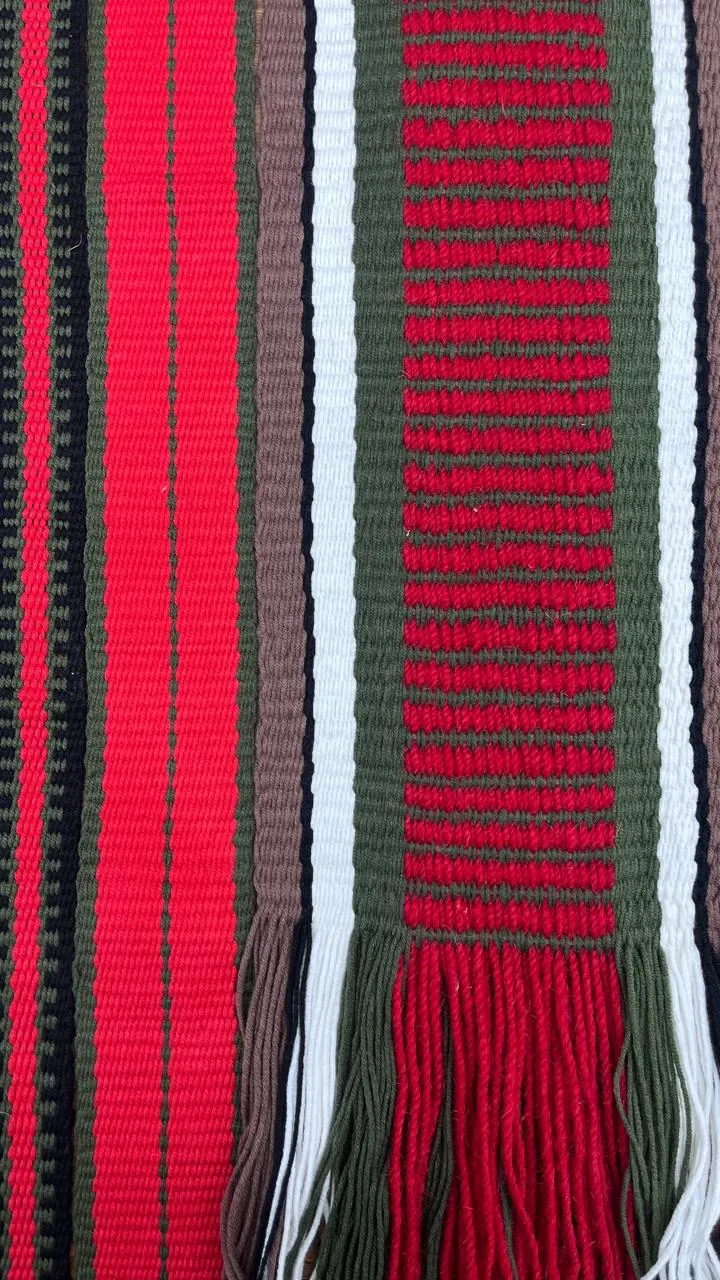
Sadu is the flat-woven textile of the Bedouin communities of the Arabian Peninsula. It is made on a ground loom, laid close to the earth, with the weaver seated beside it. The loom is simple: two beams pegged down, warp threads stretched between them, and a few sticks and a beater that shape every row. Almost everything else happens in the hands.
Material
Traditionally the yarn came from the animals of the household: sheep wool, goat hair and camel hair, spun by hand and dyed in earth reds or left in natural black, brown and cream. Those limits shaped the palette. A Sadu strip reads in a few strong colours, and red, black and white sit together with an ease that comes from long practice.
Pattern
The motifs are geometric: diamonds, triangles, zigzags and stepped lines. They are built thread by thread, with the weaver counting as she goes, so symmetry depends on memory and attention rather than a drawn plan. Bands of dense pattern alternate with plain stripes, which gives a strip its rhythm.
Pattern names and meanings differ between regions and families. Part of the work of documenting Sadu is recording them while the people who know them can still be asked.
Why it is worth keeping
Sadu began as functional cloth: tent dividers, rugs, and bags for storage and travel. That practical origin is part of its character, and part of why it can still find a place in daily life.
My own training in traditional weaving at the Royal Institute of Traditional Arts showed me how much of the craft lives in the process: the setting of the warp, the rhythm of the beater, the counting. A finished piece records all of it, which is why a Sadu strip rewards a slow look.